
-
7 min read
Dec 18, 2025, 12:59:59 PM
Share On:

Smart investors don’t hand over capital. They verify, question, and choose their partners intentionally.
Introduction: Why Asking the Right Questions Matters
Passive real estate investing attracts many high-earning professionals who want to build long-term wealth, diversify beyond the stock market, and generate income without becoming landlords or operators. But evaluating opportunities can feel overwhelming, especially when every sponsor claims to offer strong returns, market expertise, and a disciplined process.
In private real estate, the sponsor plays a central role. Their judgment, transparency, communication, and integrity directly influence the outcome of your investment. The best way to assess a sponsor’s credibility is by asking informed questions that reveal how they think, operate, and steward capital.
Below are seven essential questions that help passive investors evaluate any sponsor with clarity and confidence.
1. “What exactly am I investing in, and how does it generate returns?”
If a sponsor cannot clearly articulate the asset, business plan, and return drivers, you may not be looking at a well-structured deal.
A strong explanation should cover:
- The asset type (e.g., land development, new construction, value-add multifamily)
- The business plan and execution steps
- The timeline from acquisition through exit
- How returns are created (e.g., preferred returns, profit share, sale proceeds)
Confusion here is a sign to pause and ask for more clarity or move on.
A strong example:
Some firms provide structured frameworks that outline the asset, scope, timeline, and return mechanics so investors understand exactly how value is created before they invest. Look for this level of clarity.
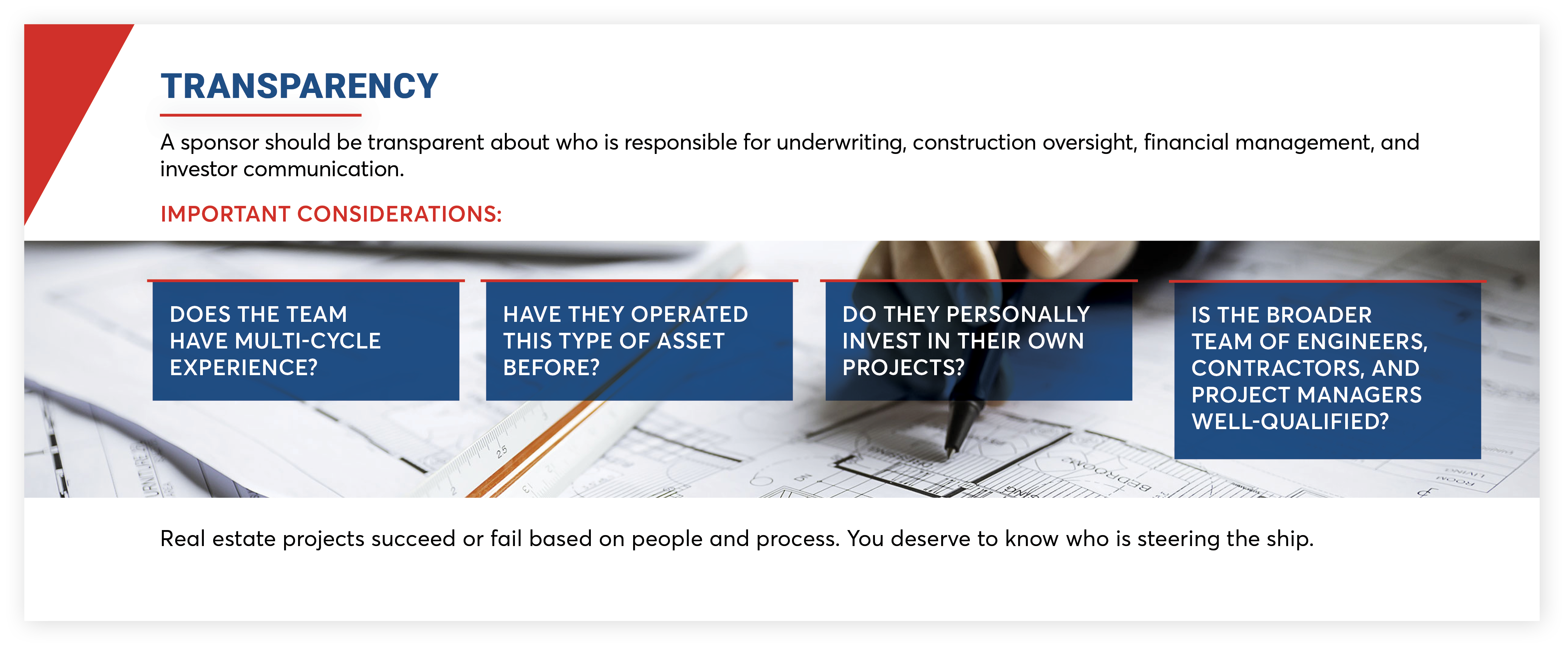
2. “Who is managing the project, and what experience do they bring?”
3. “How does the sponsor identify and mitigate project risks?”
No real estate investment is risk-free. Strong sponsors acknowledge this and proactively plan for uncertainties.
Ask about:
- Underwriting assumptions and conservatism
- Market analysis supporting demand, pricing, and absorption
- Construction risk mitigation (e.g., bulk purchasing, scheduling, contingency budgets)
- Entitlement clarity and municipal relationships
If a sponsor avoids discussing risks, that’s a warning sign. You want a partner who is disciplined, data-driven, and transparent.
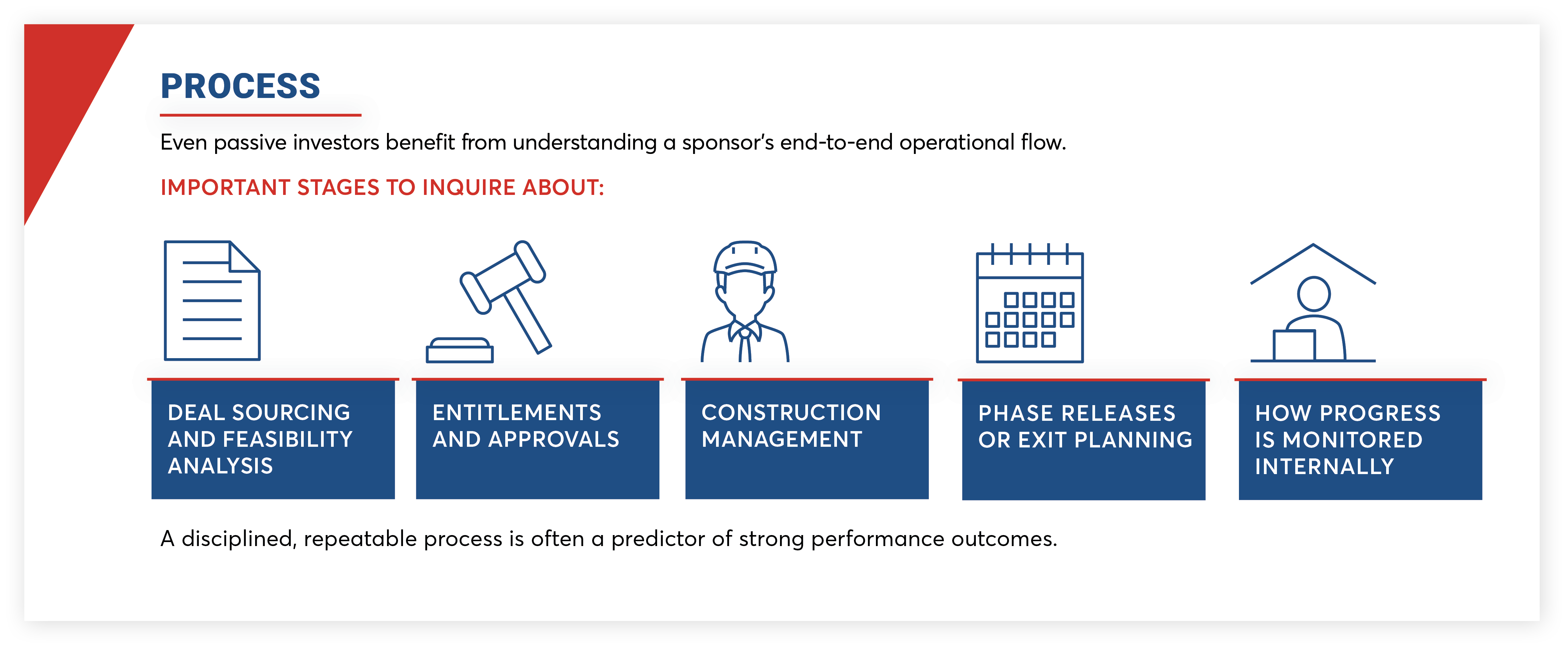
4. “What is your process across the entire project lifecycle?”
5. “How and how often will you communicate with me?”
A sponsor’s communication style directly impacts investor trust and experience.
Look for:
- Clear reporting schedules (monthly, quarterly)
- Access to investor portals or dashboards
- Direct lines to investor relations
- Updates on milestones, challenges, and wins
- Transparent explanations of tax documentation and distributions
You should never feel “in the dark” about your own capital.
6. “How are fees structured, and how do you get paid?”
Fees are one of the clearest ways to understand a sponsor’s incentives.
You should ask:
- Are there acquisition, management, or disposition fees?
- Does the sponsor only profit after investors receive preferred returns?
- Are there any hidden fees or markups?
- Is the waterfall structure clearly explained?
A sponsor should be able to discuss fees openly and simply.
7. “Is this investment aligned with my goals, timeline, and risk profile?”
Even a well-run project may not suit every investor’s needs.
Consider:
- Does the timeline align with your liquidity expectations?
- Is the risk level appropriate for your portfolio?
- Do the cash flow projections support your income goals?
- Does the strategy feel clear and understandable?
Strong sponsors help prospective investors evaluate fit, not pressure them into quick decisions.
A Practical Due Diligence Checklist
Before investing, make sure you can confidently answer:
✔ Do I understand the asset and business plan?
✔ Do I trust the team managing the project?
✔ Can I clearly articulate how risks are being addressed?
✔ Is the process organized and transparent?
✔ Will communication meet my expectations?
✔ Are fees aligned with investor outcomes?
✔ Does the investment fit my personal objectives?
If any answer is unclear, ask more questions. A good sponsor will welcome them.
Conclusion: Better Questions Build Better Partnerships
Real estate is a relationship-driven asset class. Strong sponsors operate with transparency, discipline, and alignment, and they expect investors to ask tough questions.
By using these seven questions as your due diligence guide, you’ll quickly distinguish between sponsors who value clarity and long-term relationships and those who rely on marketing gloss and surface-level projections.
This is the foundation of building a long-term investment partnership based on trust, transparency, and shared success.